Sleep Protocol (Huberman)
Protocol Overview
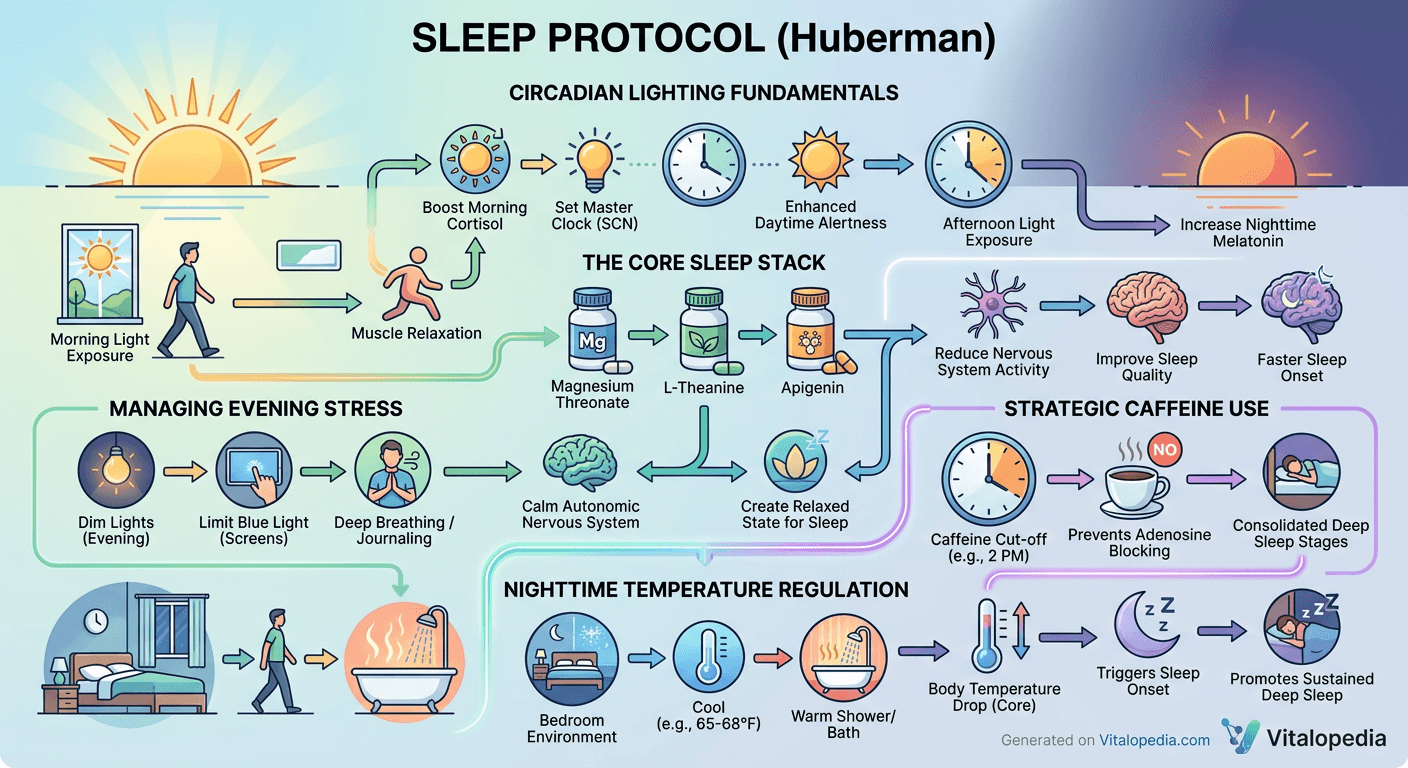
Visual representation of causes and effects within this protocol. Click to enlarge.
Mastering your sleep is the single most effective way to boost cognitive function, emotional stability, and long-term health. The Huberman Sleep Protocol emphasizes the critical role of the circadian rhythm, primarily driven by light exposure and temperature. By aligning your biology with natural cycles, you can significantly reduce the time it takes to fall asleep and enhance the quality of your rest. This protocol integrates behavioral shifts with high-evidence supplements to help you achieve restorative, deep sleep. Consistent application is key to transforming your hormonal health and overall longevity. Mastering these fundamentals creates a foundation for all other health and productivity goals.
Evidence Based Insights
Taking 1g/day of Magnesium L-threonate for 21 days significantly improved objective sleep scores (Deep and REM sleep) as measured by the Oura ring.
A 4-week trial of 200 mg/day L-theanine demonstrated reduced stress-related symptoms and improved sleep quality in healthy adults.
Oral supplementation with 100mg of GABA was shown to shorten sleep latency, allowing individuals to fall asleep significantly faster.
Standardized apigenin (from chamomile) significantly reduced symptoms of Generalized Anxiety Disorder (GAD), supporting a calmer state for sleep.
Circadian Lighting Fundamentals
Mastering your circadian rhythm begins with early morning light exposure to anchor your biological clock. Getting 5-10 minutes of bright sunlight within an hour of waking triggers a healthy cortisol spike and sets the timer for nighttime melatonin production. If natural light is unavailable, using a 10,000 lux SAD light can provide a comparable stimulus to signal the start of the day. Conversely, reducing evening light exposure—especially from overhead blue-light sources—is essential for avoiding melatonin suppression. This light-dark contrast is the most powerful signal for telling your brain when to be alert and when to prepare for rest.
The Core Sleep Stack
For those looking to optimize their sleep chemistry, a specific stack of supplements can be highly effective when taken 30-60 minutes before bed. Magnesium L-Threonate is a primary recommendation because it can cross the blood-brain barrier to support relaxation; trials show it improves objective sleep scores for Deep and REM cycles. Pairing this with L-Theanine helps lower anxiety and improves overall sleep quality by promoting a calm mental state. Finally, Apigenin, a derivative found in chamomile, acts as a gentle sedative to further ease the transition into sleep. These compounds work synergistically to quiet the nervous system and prepare the brain for unconsciousness.
Managing Evening Stress
High levels of evening stress can significantly interfere with your ability to fall asleep quickly. Supplementing with GABA has been shown to shorten sleep latency, helping you drift off faster by inhibiting overactive neural signaling. Ashwagandha is another powerful tool for stress resistance, as meta-analyses indicate it has a significant effect on improving overall sleep quality, particularly for those facing chronic stress. Reducing your biological 'stress load' in the evening is vital for preventing the middle-of-the-night wakefulness that often plagues busy professionals. These supplements should be used as adjuncts to a consistent wind-down routine that includes meditation or light reading.
Strategic Caffeine Use
Strategic stimulant management is vital for protecting your sleep architecture and avoiding fragmentation. Caffeine has a long half-life, meaning even an early afternoon cup of coffee can interfere with deep sleep quality. To optimize your rest, it is recommended to stop caffeine consumption at least 8-10 hours before your target bedtime. Delaying your first caffeine dose by 90 minutes after waking can also help clear natural adenosine more effectively, preventing a mid-afternoon crash. This approach ensures your brain's sleep pressure can build up naturally throughout the day, leading to faster sleep onset and higher-quality recovery.
Nighttime Temperature Regulation
Physical temperature regulation is a biological requirement for the transition into deep sleep. Your core body temperature must drop by 1-3 degrees to initiate the sleep cycle effectively. A warm bath or shower 60-90 minutes before bed can paradoxically assist this by drawing heat to the skin's surface for a rapid subsequent 'thermal dump'. Keeping your bedroom cool, ideally between 65 and 68 degrees Fahrenheit, creates an environment conducive to staying asleep. Avoiding intense exercise or large meals late at night prevents the metabolic spikes that can keep your body temperature too high for rest, ensuring your sleep remains uninterrupted.
Enjoying this protocol?
Get weekly longevity insights, new protocols & research highlights delivered to your inbox.
Community Experiences
No posts about Sleep Protocol (Huberman) yet. Be the first to share something!
Create Your Own Protocol
Ready to share your unique perspective? Build and share a protocol tailored to your specific goals and biology.
Vitalopedia's content is for informational purposes only and is not intended as professional medical advice, diagnosis, or treatment. Always seek the advice of your physician or other qualified health provider before making any change to your healthcare regimen.